
Cruiser (Inventory Assessment)
Realistic resource assessments for realistic tree assessments
Atlas Cruiser enables the forest manager to reliably estimate yields using forest inventory assessments.
The Cruiser tree description method takes stem assessment from an art form to a science, since features of the stem are recorded quantitatively. Business requirements can be considered when the type of cutting strategy is selected. The strategy can be either cutting logs to a priority list or cutting logs to maximise value. Growth models can also be used to calculate potential yields at future harvest dates.
| Benefits | Features |
|---|---|
| Log Cutting Decisions Based on Accurate Stem Descriptions | Each stem feature is individually assessed to build up a comprehensive description of the stem. Detailed branching, quality, and sweep specification of log grades to fully exploit the new stem description. |
| Comprehensive yield tables created efficiently | Create scenarios of multiple assessments, cutting strategies, and harvest dates, analyse and report them in one step. |
| Automated processing of large jobs for different scenarios | Multiple scenarios can be batch processed by using command-line scripts. |
| New reports created easily to meet business needs | The Cruiser user interface provides a powerful tool to construct a wide variety of reports. |
| Previously completed analyses are available | Results of each analysis are stored in the database to provide ready access to the results of the analyses. |
| Growth models to predict future yields | Both Stand-level and Tree-level models are supported. |
| Branches growth modelled over time | Branch assessments can be used with models to predict branch size growth, which improves calculations of potential future yields. |
| Calculation of production thinning yields | Log product yields are calculated for removed stems and residual stems grown forward. |
| Prediction of wood density | A wood density model is available to allow for log products with minimum wood density requirements. Log product yields are calculated for removed stems and residual stems grown forward. |
| Small area assessments using stem-based sampling | A quick sample of several trees in a small part of a stand about to be harvested will provide a useful indication of log product mix. |
| Assessments suitable for woodlots | Systematic sampling of individual trees, combined with total tree count, can efficiently predict log product yield. |
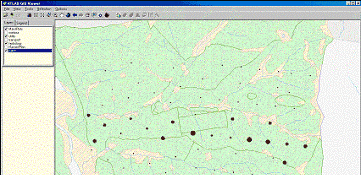
| GIS connections for the design of assessments and reporting across forest areas | Assessments can be designed with the aid of a GIS, and the GIS can be used to report the spatial distribution of product yields. |
Assessment
Cruiser provides a straightforward assessment method to obtain a comprehensive and objective description for each stem.
There is no ambiguity about how to record details since stem features, such as branching or sweep, are assessed independently. All that is required is for the assessor to take one feature, observe the entire length of the stem, and record dimensions and start and end points for any occurrence of the feature. This process is repeated for each stem feature.
Data
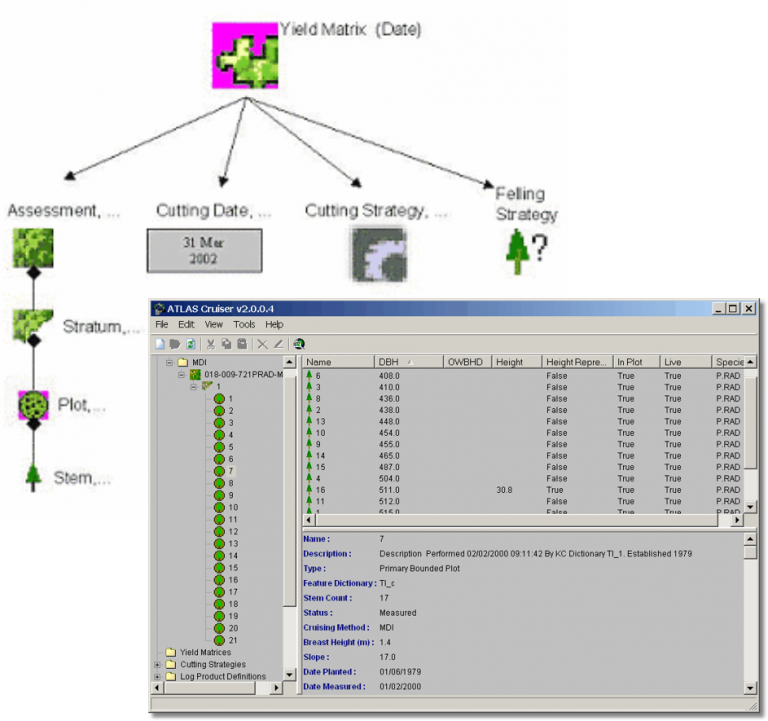
It is possible to view and edit all of the assessment data from one application
A hierarchy of folders can be created to organise assessment data into logical groups. The forest manager will find the layout and functionality easy to use as it is consistent with Windows® Explorer. For example, a click on the height column in the list view will sort all stems in a plot by height.
Yields
The Cruiser Inventory Assessments of stems ensure that potential yields can be reliably determined from the specified log-product definitions and strategies
There are two options for log cutting: to fulfill a priority list of log types or to achieve maximum value from each stem based on specified log prices. The log-product grade definitions and values used can be reused or repeatedly changed. A wood density model is available to calculate log density so that any log products constrained by a minimum density can be incorporated. Recovery of top pieces and multi-breakage prediction can further refine yield estimates.
Predictions
Cruiser predicts stand growth over time by using species-specific growth models based on stands or individual trees.
Branch size is a major determinant in log quality, so yield predictions are improved by modeling branch growth over time using branch data from the inventory assessment. Log product yields produced by thinning a stand can be calculated by applying rules about which stems will be removed. The residual stems can be grown forward to provide any future thinning or clear-felling yield predictions.
Scenarios, which may be based on several assessed blocks, different harvest dates, and cutting strategies, can be selected interactively and analysed and reported at once. Alternatively, command-line scripts can be written to automate large processing jobs.
Cruiser fully supports the analysis of MARVL assessment data.
Cruiser integration with our Forestry suite for Forest Management Tools
Integration between ATLAS modules enables information from one application to be accessed or presented within another, which greatly increases the power of each individual module and the suite as a whole. For example, Assessment data can be collected by FieldMan, and summaries can be stored in GeoMaster. The yield tables produced by Cruiser can be saved in Yield Table Manager so they are widely accessible.